How healthcare systems can better serve patients of all body sizes
Associate Professor Caz Hales says peoples’ body size should not be a barrier to accessing healthcare, and providers need to address unconscious weight bias.
Whether it’s beds that are too small, gowns that don’t fit, or being on the receiving end of weight bias from health professionals, structural discrimination against people of size can have potentially life-threatening implications for their care and wellbeing.
That’s a serious issue, explains Associate Professor Caz Hales, who says everyone should have equitable access to healthcare, no matter their body size.
Caz is the Programme Director of Professional Doctorate programmes at Te Herenga Waka’s Te Puna Hauora (School of Health) and adjunct bariatric research and service development advisor for Health New Zealand—Te Whatu Ora Capital, Coast and Hutt Valley.
She is a registered nurse who researches obesity care within health systems, both in Aotearoa and overseas, and educates healthcare providers working on the front line.
The approach to caring for people of size needs to be reframed away from treating obesity as the problem, to creating healthcare environments that are welcoming and accessible for people living with obesity.
Associate Professor Caz Hales
Deputy Director
Weight stigma starts before the clinic door
In some cases, weight stigma means patients don’t even make it as far as to the door of the clinic or hospital, explains Caz.
“So many patients of size never engage with the healthcare system because they have a perception that they won’t get the care they need—they feel there’s no point. The discrimination is structural—automatically, they are marginalised because there isn’t equipment that fits, such as blood pressure cuffs, or gowns that provide dignity. Appropriate equipment should be business as usual, not something that limits people’s access to care provision,” she says.
“Then there are things like non-size inclusive signage that only shows smaller bodies, or clinical practices that have scales in the waiting room where other people can see you being weighed. Maybe someone arrives at the waiting room and pretends to read the posters on the wall as a strategy to avoid sitting down, because there are no chairs that fit them. All these things might be unintentional on the part of the healthcare provider, but for the person of a larger body size it’s a very intimidating, stigmatising, and shaming environment to be in.”
Designed with communities, for Aotearoa
Caz’s research looks at how to break down these myriad accessibility barriers.
“Size should never be a limiting factor to care, so a lot of my work is educating healthcare providers to think about strategies for dealing with any unconscious biases they or their team might have, or the kind of equipment they’re purchasing and whether it’s size-inclusive.”
Caz recently partnered with a company called Essential Helpcare, who provide bariatric equipment and services across Australasia, as well as British patient advocate Tracey Carr, and Nadia Pantidi from Te Herenga Waka’s School of Design Innovation, to develop an app called Weigh Your Bias.
“We’ve collaborated on a project where design students have come into the hospital and heard from a patient advocate about his experience of living in a larger body. The students then had to design something that would make healthcare more accessible and inclusive, based on this lived experience,” Caz says. “Two students devised a weight bias app that held a lot of promise, so we invited them to work with us to make it a reality.”
Weigh Your Bias is a learning package specifically for healthcare professionals, providing guidance on size inclusive healthcare and how to address weight bias. It’s set to be released in early 2026 by Essential Helpcare to health professionals across Aotearoa and Australia as part of their Bariatric Excellence Home Sooner Institute.
“It’s really exciting to leverage off the drive and excitement of these amazing students, who want to make meaningful change to society,” says Caz. “For them, it’s an opportunity to apply the skills they’ve gained from their qualifications to a real-life research project, and they own the intellectual property to it, as well.”
A VR world for empathy and safe practice
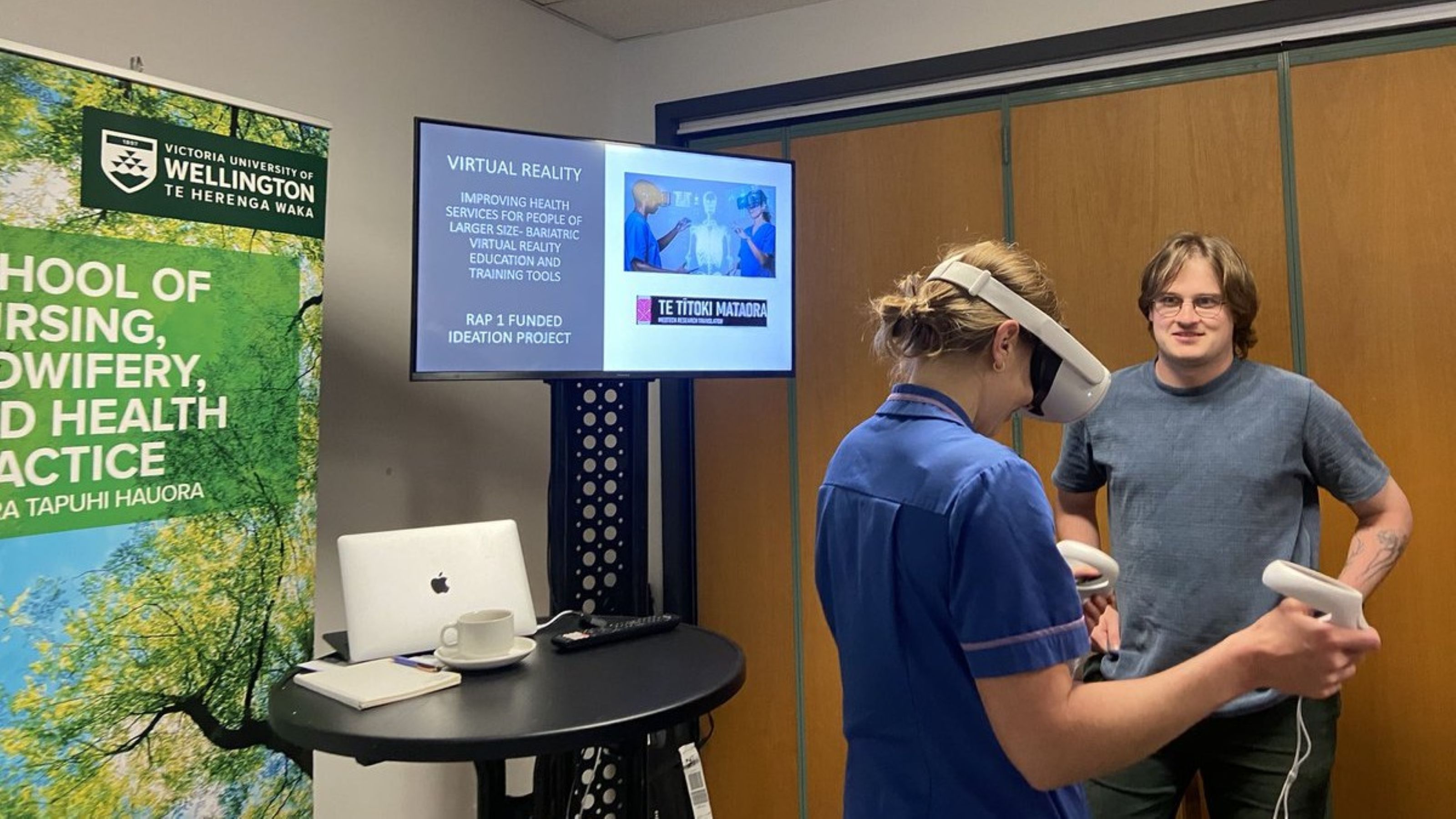
Another collaboration with the School of Design Innovation and Health New Zealand—Te Whatu Ora has seen students help develop a virtual reality education platform that aims to complement existing training of healthcare professionals and students around making services inclusive for people of size. The platform includes modules on empathy and cultural safety, risk assessment, and safe patient handling.
“This is a crucial aspect of care where sometimes patients or staff can get hurt, so it’s important to be able to do it safely,” explains Caz.
We wanted to develop a VR world where users can think about moving and handling practices, as well as weight bias, empathy, clinical decision-making, and what to consider in terms of facility design.
Associate Professor Caz Hales
Deputy Director
The VR bariatric education project has received funding by MedTech and has been co-designed from the start by paramedics, clinical and nursing staff, healthcare and UX (user experience) design educators, Māori and Pasifika community advocates, design students, and alumni.
“We’re working with a range of communities, including Māori and Pasifika, to ensure the communication interaction aspects of the tool represent Aotearoa’s unique cultural perspective. We’ve interviewed a range of people, and from that we’re building narratives for these virtual patients so that they’re fully-formed characters with families and histories and back-stories,” says Caz.
The project is ongoing, and the team is already engaging in new research and commercialisation opportunities.
“We’re doing body scans of people of larger size and doing some motion capture work so that these virtual patients are representative of real people of size in our communities,” Caz says.
“Virtual patients who accurately represent the proper gait and movement of a person of size mean the healthcare workers using the VR tool will be able to consider safe practice, correct equipment, and the appropriate clinical environment so that different patient manoeuvres can be carried out safely.”
Better outcomes for all patients
Caz says her research is all done with the goal of making the patient experience better.
“Wherever someone is on their healthcare journey, their body size should not be a limiting factor to them accessing care within Aotearoa New Zealand. For us as health professionals, it’s our role to reframe the narrative and ensure that the individual isn’t the place where we point the blame—the problem actually lies with the system that doesn’t work for them,” she says.
“In this day and age, we know more and we can do better. Transforming healthcare environments requires a comprehensive approach, but if we do it right it’s going to remove that reluctance of some people to engage with the healthcare system, which is crucial for their safety, dignity, and their right to access high-quality care.”
Find out more about research at Te Puna Hauora—School of Health.